Business
Privacy Policy and SMS Terms for Service Businesses
By Fidyan Ahmed, founder · Published · 7 min read

On this page
A privacy policy for a small business is a plain page about what you collect and what you do with it. If you also text customers, you need consent and a real way for them to opt out. This article points at public rules. It is not legal advice.
Key takeaways
- Say what you collect if the site asks for a name, a phone number, or an email.
- Do not treat a web form as automatic permission for marketing texts.
- Honor a stop reply. The federal rule lists several words that count.
- Update the policy when you add a form, a tracker, or a texting program.
When you need a privacy policy
If people can send you their name, phone number, or email, you are collecting personal information. Tell them what you collect, why you collect it, and whether you sell it or hand it to a texting company. Use short sentences. A policy nobody can read does not inform anyone.
There is not one federal sentence in this guide that says every one truck company must use the same policy. State laws differ, and some apply only after a size test. Do not guess that you are too small, and do not guess that every California rule applies to you. The California Attorney General explains the state privacy law on the CCPA page. Read it, or ask a lawyer, before you decide. This blog cannot make that decision.
Also say who you are. Put the business name and a way to reach you. If a vendor hosts the form, say so. Do not copy a policy from another trade and hope the tools match.
Picture a painter whose form asks for a phone number and a photo of a room. The policy page still says the site collects nothing. That page is false. She rewrites it to mention the form, the photo, and the fact that she uses the number to reply about the estimate. The quote form guide is the sister problem: asking for the right facts, then telling the truth about them.
This week, open your form and your policy side by side. Every field on the form should be something the policy admits. If you have no policy page, draft one before you add another field. The Privacy Policy and Terms Generator is the tool for that draft.
Until it is live, read the draft with the Content Checker so the sentences stay short enough to understand.
Texting customers: consent and opt out
Texting is not a casual extra on a form. Federal delivery rules live in 47 CFR 64.1200, checked 23 Nov 2026. The rule is amended from time to time, so read the current version. In short, the rule says no one may use an automatic telephone dialing system or a prerecorded voice to call a cell phone unless the call is an emergency or the person gave prior express consent. A later paragraph says that, for that part of the rule, a call includes a text message.
Ads and telemarketing texts use a stricter consent. The rule defines prior express written consent as a signed agreement that clearly allows those messages and states the number, with a clear disclosure. Do not hide that yes under a prechecked box. Ask a lawyer to read the paragraph before you launch. This summary is not a substitute.
People can revoke consent by any reasonable method. The rule says a text reply using stop, quit, end, revoke, opt out, cancel, or unsubscribe is a reasonable way. Build the program so those replies work. Do not require a phone call during hours you do not answer. Send a confirmation that you will stop, and then stop.
Picture a cleaner who adds a line under the form: "text me deals." It is prechecked. She buys a tool that texts the whole list every Friday. A customer who only wanted a quote replies stop and still gets three more texts because the tool was never connected to that word. She unchecks the box, asks for a clear yes, and tests stop before the next Friday.
This week, look at your form. If a box opts people into texts, make sure it is not prechecked, say what they will get, and send yourself a test that includes the word stop. Confirm the test actually stops.
Cookies and analytics
Cookies and similar tools can remember a visit or count it. If you only need to know that the form was sent, you may not need a pile of trackers. If you add analytics or ad tags, say so in the policy. Name the purpose in human words: "we count visits" or "we measure ads." Do not paste a policy that lists ten tools you turned off last year.
This article will not invent a banner style and call it the law in every state. Rules differ. What you can do this week is make the policy match the tools that are actually on the site. If a new plugin adds a tracker, update the policy in the same week. The ownership guide is a reminder that you should know which tools you installed. A tracker you do not remember is still your responsibility.
Be careful with job photos and forms. A photo of a kitchen may show a face, a letter, or a house number. Do not upload what you do not need. If a form stores the message in a third party tool, the policy should not claim that only you can see it.
Picture an HVAC site that added an ad pixel during a busy season and never mentioned it. The policy still says the site does not track anyone. He either removes the pixel or tells the truth in the policy. Both choices are cleaner than a page that lies.
This week, list every tool that runs on the site. Compare the list to the policy. Delete the mismatch, either by removing the tool or by editing the page.
Keeping policies up to date
A policy is a living page. Change it when you change the business. New form fields, a new texting vendor, a new analytics tool, or a new office address are all reasons to edit. Put a date on the page so you can see which version is live. Keep the old version in your files in case someone asks what the page said last spring.
Read it once a year even if you think nothing changed. Vendors change their own terms. Your memory of what the form collects will drift. The yearly read is short if the page is short. Website maintenance can include this check so it does not depend on a busy owner remembering in December.
Do not promise "we never share data" if you use a host, an email tool, or a texting platform. Those companies see what you send them. Say that you use service providers to run the site and the messages. If you do sell lists, say that plainly. If you do not, say that plainly too.
Picture a garage door company that starts texting appointment reminders and leaves the policy silent. A customer is surprised. The fix is one paragraph: what the text is, that they can reply stop, and who sends it. He adds the date at the bottom. The next change will be obvious.
This week, put a reviewed date on the policy and schedule a note for the same month next year. If the page has no owner, name one person who is allowed to edit it.
Generating yours
A generator is a form that assembles sentences from facts you provide. It is useful when the facts are true. It is harmful when you click through and publish fiction. Before you generate anything, write a list: what the form collects, whether you text, whether you use analytics, and how a person can reach you. The Privacy Policy and Terms Generator is meant to turn that list into a draft.
Read every sentence. Delete tools you do not use. Add the stop instruction if you text. Link the page from the footer and from the form. Ask a lawyer to review it, especially the texting section, because the federal rule is detailed and this article is only a map. Then test the form. Submit a sample with a name like a test, and confirm you can find that submission and delete it.
| Topic | Say it in plain words |
|---|---|
| What you collect | Name, phone, email, photos, or messages |
| Why | To answer the request, or to send texts they agreed to |
| Texting | What you send, and that stop works |
| Tools | Analytics or ads, if you actually use them |
| Contact | A real email or phone for privacy questions |
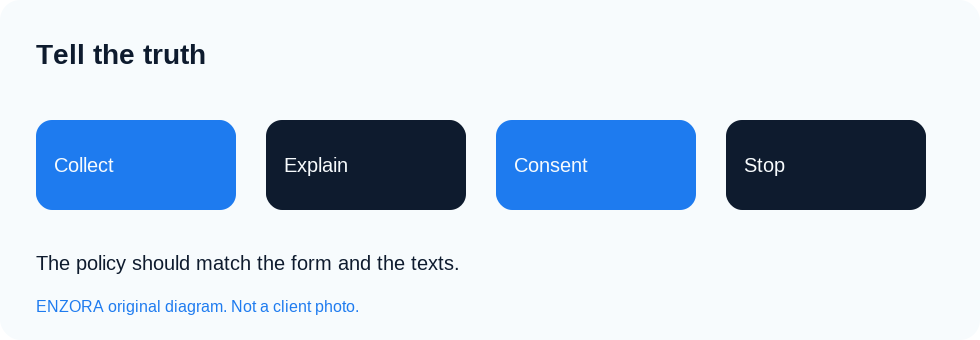
This week, publish nothing until the draft matches the form. A short true page beats a long page you copied. The policy path diagram is that order.
Want us to fix this for you? Get a free fix plan.
Questions
Does every small business need a privacy policy?
Not from one sentence in this article. If your site collects names, phone numbers, or emails, tell people what you collect and why. Some state laws require a notice, and they do not all use the same size test. Read the law that might cover you, or ask a lawyer. This is not legal advice.
Can I text customers who filled out my form?
A form is not automatically permission to run a marketing text campaign. Federal rules limit autodialed and prerecorded calls to cell phones, and those rules also discuss text messages. Get clear consent before a system texts people, and honor a stop reply. Ask a lawyer before you buy a texting tool.
What counts as opting out?
The rule says people may revoke consent by any reasonable method. A reply that says stop, quit, end, revoke, opt out, cancel, or unsubscribe is listed as a reasonable way. Do not bury the only off switch in a call center that never answers. Honor the reply.
Do I need a cookie banner?
This article will not invent a banner rule for every state. If you use analytics or ads that track visitors, say so in the policy in plain words. Name the tool. If you add a new tracker, update the policy the same week. A banner that hides the real tools is worse than silence.
Can a generator write my policy for me?
It can draft a starting page from facts you type. You still have to read it and make it true. A policy that mentions tools you do not use, or hides tools you do use, is a problem. Have a lawyer review it before you rely on it. Then put the page where people can find it.
Was this helpful?
Related ENZORA services
Want help with your website?
Get a fixed quote from the ENZORA team. We work with businesses worldwide.