SEO
Keyword Difficulty Explained for Local Business Owners
By Fidyan Ahmed, founder · Published · Last updated · 8 min read

On this page
Keyword difficulty is a score some SEO tools invent to guess how hard a phrase might be to rank for. Google does not publish that score. For a local shop, the map and the towns you really serve matter more than a gauge on a paid screen.
Key takeaways
- A difficulty score is a third party hint, not a Google number.
- Local phrases also depend on how close the searcher is.
- Pick phrases you can answer with a real page this season.
- Use a free phrase list, then write the page. Do not wait for a perfect score.
What keyword difficulty really measures
A difficulty score tries to predict competition. The tool looks at the sites already showing for that phrase and at the links and pages it knows about. Different tools use different math, so two screens can disagree about the same phrase. That does not mean one of them is Google. Google's note on third party SEO tools (checked 23 Nov 2026) says those tools do not have Google's internal ranking data, they cannot guarantee performance, and their predictions are their own.
Use the score as a way to sort a list, not as a verdict. A low score does not promise you will rank. A high score does not forbid you to write the page. The page still has to be true, clear, and useful to a person on a phone. If the only reason to write it is the score, skip it.
Picture two tools opened on the same phrase, "water heater repair" plus a city. One gauge looks friendly. The other looks stern. The owner freezes. The customers did not freeze. They still need a page that says you repair water heaters in that city, with a phone number. Write the page because the job is real. Let the scores argue in the background.
This week, if you have a score in front of you, write down what the tool claims it means, in the tool's own help page. If you cannot find that page, do not steer the business by the gauge. The live Keyword Ideas tool is the list you can use today. SEO growth work should start from phrases you can defend, not from a screenshot of a gauge. Try Keyword Difficulty Checker and Google Maps Rank Grid if you want those checks.
Why local keywords behave differently
Local results are not only a list of blue links. Google's tips to improve local ranking (checked 23 Nov 2026) say local results are mainly based on relevance, distance, and popularity. The page then explains popularity as prominence: how well known a place is, including reviews and links. Distance is how far the business is from the person who searched. You cannot move the customer closer by editing a keyword tool.
That is why a phrase can feel easy on one street and hard on another. A shop with a strong profile near the searcher can show in the map pack while a famous national page shows in the links below, or the other way around. A single difficulty number rarely says which of those you are looking at. If the tool does not say "map" or "local pack," assume it is talking about ordinary web results.
Picture a painter who ranks in the map pack near the shop and not at all on the far side of the same city. The keyword tool shows one score for the city name. The score did not fail. It never measured the streets. The local SEO guide walks through how the profile and the site should agree. Local SEO is the work when the map is the goal, not a national article.
This week, search your main job from the shop phone and from a phone on the other side of town, or ask a customer to look. Note whether you appear in the map list, the links, or neither. Write that down next to any difficulty score so the score is not the only column.
How to read a score without a paid tool
You can make a plain reading without a subscription. Start with the phrase a customer would say. Look at the current page that shows, on a phone, in the town. Ask whether that page belongs to a local company that does this job, whether it answers the job in the first screen, and whether you could write a clearer page without copying them.
If the screen is full of directories and none of them explain the job, you have a chance to be the clear local page. If the screen is full of companies with real crews in that town, you still write your page, and you also work on the profile, the reviews, and the basics. The score is not what makes the crew show up. The profile and the page do.
The Keyword Ideas tool groups phrases for a service and a city. When it cannot get a live list from Google, it says so. It does not invent a search volume to fill the gap. Pair that list with the words on your call log. A phrase you hear every week belongs on the site even if no tool has scored it. The SERP Preview shows how a title may be cut. It does not show your rank. Do not treat a preview as a position.
This week, build a list from the tool and from the office. Mark each phrase as map, web page, or both. Drop any phrase for a job you do not sell. You now have a working list that did not require a paid difficulty suite.
Picking keywords you can win this quarter
A phrase you can win this quarter is one you can support with a real page, a real profile category, and a crew that will do the work. "Win" does not mean a promise of first place. It means the phrase is a fair use of your time. Google's SEO starter guide (checked 23 Nov 2026) says there is no secret that automatically ranks a site first. Plan the work you control.
Prefer the job plus the town over a vague national phrase. Prefer the words customers use over the words a vendor thinks sound premium. Prefer one strong page per job over a pile of thin town pages you will not update. A thin page for a town you do not serve is a trust problem, not a growth idea. Google's business representation guidelines (checked 23 Nov 2026) say the profile should match the real business, including a precise service area.
Picture a pressure washing company that builds a page for every neighborhood name it can find, with the same short paragraph and a swapped city. The difficulty scores look like easy wins. The pages are not useful. Write one honest service area page, then separate pages only for jobs that need different explanations, such as houses versus fleet trucks.
This week, circle the phrases that already match a page you have, and the phrases that need a page you can finish this month. Leave the rest. SEO growth can help turn that short list into pages and profile edits. The rank tracking guide is how you watch the list later without pretending a daily scrape is required.
A worked example for a plumber in Austin
This is a teaching sketch, not a report about a real company and not a volume study. A plumber in Austin wants more water heater work and fewer calls for jobs they do not offer. They open Keyword Ideas for water heater repair and the city. They also write down the phrases from last week's calls: no hot water, leaking tank, flush versus replace.
They do not chase a national phrase about the history of water heaters. They do not build a page for a suburb they will not drive to. They make sure the Google profile categories and services mention water heaters, because relevance is one of the local factors Google names. They look at the home page and the water heater page on a phone. The number is tappable. The towns are true.
They note, from their own phones, whether the map list shows them near the shop. They do not convert that look into a fake citywide rank. If a difficulty tool is on the desk, they write its score in a column labeled with the tool's name, so nobody later thinks the number came from Google. The decision to write the page came from the calls, not from the gauge.
This week, copy that sketch with your trade and your city. One job. The towns you serve. The phrases customers say. A page that answers them. A profile that matches. That is a quarter's first step. The domain strength guide explains why a famous score about your whole domain is a separate question.
A checklist you can use this week
Use the list as a pass, not as a scoreboard.
| Step | Question | Done when |
|---|---|---|
| Source | Is this phrase from customers or from a tool? | You can say which |
| Truth | Do we do this job in this town? | The page and the profile agree |
| Map | Did we look at the map list, not only the links? | A note from a real phone |
| Score | If a gauge exists, whose gauge is it? | The tool name is written down |
| Page | Does the first screen answer the job and show the number? | A thumb can tap it |
| Skip | Are we ignoring towns we will not serve? | Those pages are not published |
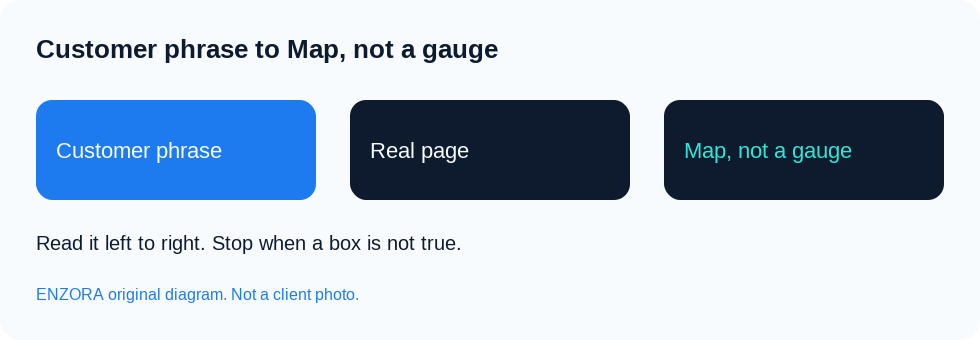
The difficulty diagram puts the gauge to the side and the customer phrase in the middle. Run Keyword Ideas once for the job you want most. Then stop collecting and start the page.
Next step
Want us to sort the phrases with you? Get a free fix plan. Tell us the jobs and the towns. We will not invent a difficulty number or a rank promise.
Questions
Does Google publish keyword difficulty?
No. Google does not hand you a difficulty score for a phrase. Tools from other companies invent their own scores from the data they can see. Google's own note on third party SEO tools says those tools do not have Google's internal ranking data and cannot guarantee a result. Treat a score as a hint from that tool, then look at the real page and the real map.
Why is a city phrase different from a national phrase?
A national phrase can be a fight with big sites. A local phrase is also a fight with distance. Google's Business Profile help says local results lean on relevance, distance, and popularity. A plumber across town is not the same result as a plumber on the same street. A difficulty score that ignores the map is only half the story.
Should I avoid every phrase that looks hard?
No. Avoid phrases you cannot honestly serve. A hard phrase that is exactly your job can still deserve a page, because the page helps a customer even before it ranks. Skip phrases for towns you will not drive to, and skip phrases that mean a different trade. Write the page for the person, not for the score.
Can I see phrase ideas without a paid suite?
Yes. The Keyword Ideas tool on this site groups phrases for a service and a city. When Google does not answer, the tool says so instead of inventing a volume. You can also read the words customers use on the phone and turn those into page headings. A notebook from the office is a real source.
How many phrases should a small shop track?
Track a short list you will actually review. Start with the jobs you want and the towns you serve, plus your business name. Add a phrase when a page exists for it. Drop a phrase that does not match the work. A long list you never open is not a plan. The rank guide explains how to watch the list without a costly suite.
Was this helpful?
Related ENZORA services
Want help with your website?
Get a fixed quote from the ENZORA team. We work with businesses worldwide.