SEO
How to Check Your Backlinks for Free (and What to Do Next)
By Fidyan Ahmed, founder · Published · Last updated · 7 min read
On this page
You can check backlinks free with the links report in Google Search Console, after you verify the site. A backlink is another site pointing at yours. Keep the mentions a real person meant. Do not buy a pile of links to look popular.
Key takeaways
- Start with Search Console's links report, not a random score.
- A useful link helps a person. A scheme tries to fool rankings.
- Earn local mentions you can explain. Do not buy them.
- Check on a calm schedule. Do not chase a daily count.
What a backlink is in plain English
A backlink is a path from their page to your page. If the lumber yard lists you as a contractor and links your site, that is a backlink. If you link from your home page to your contact page, that is an internal link, not a backlink. People use these paths to move. Search engines see them too.
Google's spam policies (checked 23 Nov 2026) describe link spam as creating links mainly to manipulate rankings. The examples include buying or selling links for rank, excessive partner swaps, automated link programs, and low quality directories. The same page says advertising links are fine when they use a rel attribute such as sponsored or nofollow, so the link is not pretending to be an unpaid mention.
Picture a customer who finds your electrician because the city's habitat group linked the volunteers from last spring. That link is a favor to the reader. Picture a different email that offers a bundle of links for a fee on sites you have never visited. That offer is the scheme the policy describes. Delete the email. Do not "test" it on a spare domain you care about.
This week, explain a backlink to the person who answers your phone, in one sentence. If the next vendor call uses the word authority and will not show a real page, end the call. SEO growth should be able to show the page a link lives on. Try Backlink Checker and Domain Authority Checker if you want those checks.
Where free backlink data comes from
Free does not mean complete. Google's links report help (checked 23 Nov 2026) explains the Search Console report of links to your site. You only see it for a property you verified. The report can show who links to you and which of your pages they point at. It will not match every paid tool, because each crawl sees a different slice of the web.
Third party tools build their own indexes. Google's third party tools note (checked 23 Nov 2026) says those tools do not have Google's internal data. A bigger count in a paid tool is not a prize, and a smaller count is not a crisis. Start with the report you can open for free. If a tool disagrees, open the actual page and see if the link is real.
Picture an owner who pays for a screenshot that says they have a huge link count, then cannot find those links in Search Console or on the open web. The screenshot was the product. Verify the site, open the links report, and click through a sample. If the page is gone, the link is not helping a customer today.
This week, verify your domain in Search Console if you have not. Open the links report and export it. The Broken Link Checker is a different job: it looks at links on your own home page that lead to an error. It does not list the world's links to you. Use it so your own page is not sending people to dead addresses. The Website Audit is the wider plain check of that page.
Good, useless, and harmful links
A good link is one a person might follow. Your supplier, a charity you really helped, a local news story about a project you finished, a manufacturer page that lists real installers. You can explain it in a sentence. The page is about the topic. The link is not hidden.
A useless link is one nobody will see and nobody earned. A page of unrelated company names, a comment on a forgotten blog, a footer that repeats on many template sites. It may not hurt. It is not a plan. Do not spend the week collecting more of them.
A harmful pattern is one that exists to manipulate rankings. Buying links, trading links at scale, or paying for an article whose only job is a keyword rich link. Google's spam policy lists these. If you paid for a mention, ask for the sponsored or nofollow treatment the policy describes, or do not do the deal. The domain guide explains why a score that rises after a scheme is not a Google reward.
Picture a landscaper asked to swap links with a crowd of unrelated shops across the country. "You link me and I link you." The policy calls out excessive exchanges. Decline. One link from the nursery you actually buy from is enough to be proud of.
This week, sort a sample of your export into notes: would follow, ignore, and we created this scheme. Only the scheme note needs action. Do not upload a disavow file because a tool colored a row red. Read Google's own disavow help inside Search Console before you touch that tool.
Local link ideas for contractors
Earn links by being useful in public. These are ideas, not a quota. Do the ones that are true for you.
- Ask a supplier you buy from to list you, if they already list real contractors.
- Sponsor a team or a cleanup you will actually show up for, and ask for a mention only if the page already thanks sponsors.
- Offer a seasonal safety note to a community newsletter you belong to.
- Publish a photo story of a finished job, with the customer's permission, and share it with the neighborhood group.
- Join the chamber or the trade group you will really attend, and complete the member profile.
- Ask the manufacturer whose products you install how installers are listed.
- Write a short page that answers a question your calls already ask, so others can point to it.
- Offer a real quote to a local reporter when a storm or a season makes your trade news. Do not invent a damage figure.
- List your profile on the official directories you control, such as the major maps, and keep the name and phone the same. The Citation Sites list is a starting set of sign up pages, without invented scores.
- Fix the partner logos already on your site so they link to the real partner, and ask them to link back only if they want to.
This week, pick one idea you can finish without paying for a link. Do that one. A single true mention beats a bundle you cannot explain. Local SEO includes this kind of real world match between the site and the profile.
How to track new and lost links
Tracking is a note, not a hobby. Once a month, open the links report and see what is new. When a partner says they added you, check that the link loads and that it points at the right page. When a link disappears because a page was redesigned, decide if a polite ask is worth it. Do not panic over a count that moves.
Keep a simple sheet: the other site, the page they linked, the date you noticed, and whether you expected it. You do not need their secret score. If you later use a paid tool, label its numbers with the tool's name so they are not confused with Search Console.
Picture a roofing company that loses a link when the supplier rebuilds a page. A friendly email to the person they already know is fine. A blast to strangers asking for links is the pattern to avoid. The keyword guide is the other half: phrases and links are different jobs. Do both slowly.
This week, add a monthly reminder to open the links report. If you have never exported it, the first export is the baseline. Do not buy a domain score to decorate the sheet.
A checklist you can keep
| Check | Good | Stop |
|---|---|---|
| Source | Search Console links report | A screenshot with no pages |
| Sample | You opened the other site | You trusted a count |
| Reason | A person would follow it | You cannot explain it |
| Money | Unpaid, or marked sponsored | Bought for rankings |
| Match | Name and phone match your site | A different city or number |
| Habit | A monthly look | A daily panic |
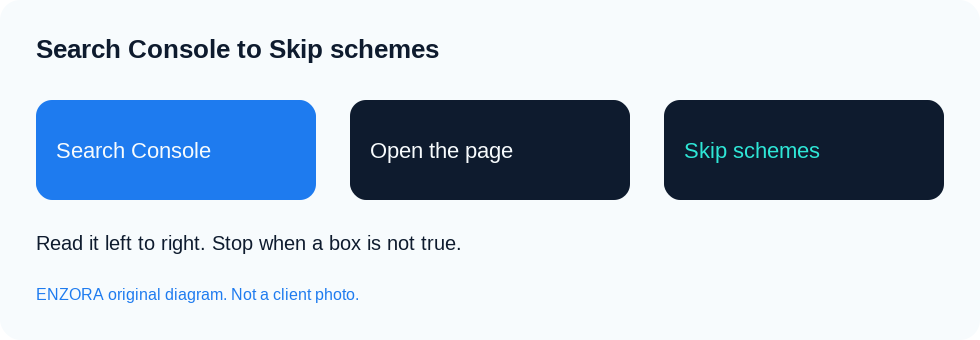
The link diagram is one honest path from their page to your phone number. Run the Website Audit on your home page so the place people land is not broken. Then go earn one real mention.
Next step
Want help sorting a links export? Get a free fix plan. We will look at the real pages. We will not sell you a bundle of links or invent a count.
Questions
What is a backlink in plain English?
A backlink is a link on someone else's site that points to yours. A supplier page that names you and links your contact page is a backlink. A button on your own site that goes to your own about page is not. Links help people move around. Google also describes some link schemes as spam when the point is to manipulate rankings rather than to help a person.
Where can I see links without paying a suite?
Google Search Console has a links report for sites you have verified. That is the free official list Google is willing to show you. It is not every link on the internet. Third party tools have their own crawls and their own gaps. If you have not verified the site, do that before you trust any outside list. The report is the place to start.
Are more links always better?
No. A link from a real local page can help a person find you. A pile of links you bought, or a footer link stuffed into sites you do not know, can violate Google's link spam policy. Quality and honesty beat a count. If you cannot explain why the other site would mention you, do not chase that link.
Should I disavow links I do not recognize?
Not as a first step. A careless disavow file can throw away links you wanted. Export the list, look for an obvious scheme you created, and read Google's disavow help before you upload anything. If you did not buy links, you may not need the file at all. Open the real page before you call a link junk.
How often should I look?
Look when you publish something new, when a partner says they linked you, and on a calm monthly pass. You do not need a daily watch. Note new links you expected and links you did not. If a whole batch appears from sites you have never heard of, read the spam policy before you celebrate.
Was this helpful?
Related ENZORA services
Want help with your website?
Get a fixed quote from the ENZORA team. We work with businesses worldwide.