SEO
Find the Keywords Your Competitors Rank For
By Fidyan Ahmed, founder · Published · Last updated · 7 min read

On this page
Competitor keywords are the phrases a rival page covers that your site still skips. You find them by reading public pages and your own Search Console, not by inventing a rank. Then you turn each real gap into a page a customer can use.
Key takeaways
- A keyword gap is a topic a rival explains and you do not.
- Pick rivals who sell the same jobs in the same towns.
- Split missing pages from weak pages before you write.
- Build one cluster into one page, then move to the next.
What a keyword gap is
A keyword gap is a plain mismatch. A customer types a job and a place. A rival has a page that answers it. You do not. The gap is the missing answer, not a magic number. You do not need a paid rank chart to see it.
Picture a plumber who has one page called services. A rival has a page for slab leaks and a page for water heaters. The plumber already fixes both. The gap is those two missing pages. The rival did not win a secret prize. They wrote the jobs down.
Google's performance report shows queries, clicks, and impressions for a site you own. Checked 23 Nov 2026, it does not list another company's keywords. Use it to see phrases you already show for. Then read the rival page for topics you never wrote.
Do not run a tool that fires lots of automated searches. Google's spam policies, updated 28 Aug 2026, treat machine made queries to Search as abuse. Read public pages yourself. That is allowed. Scraping the result page is not the method here.
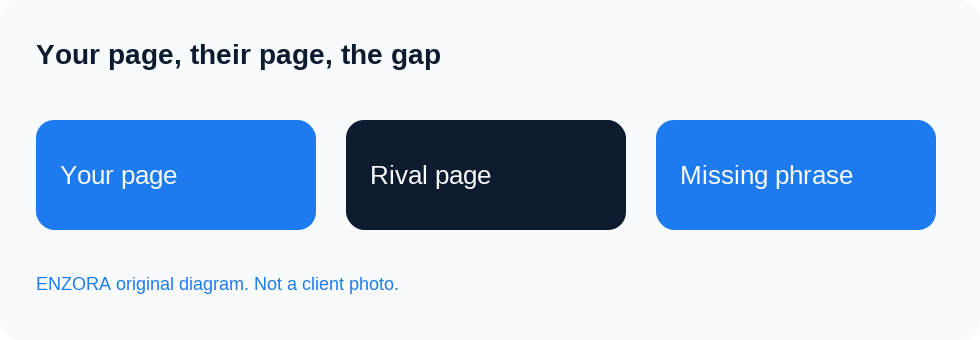
The gap diagram shows three boxes. Your page, the rival page, and the phrase only the rival names. Use that picture when you explain the work to a helper.
This week, pick one rival URL and one of your URLs. List five jobs on their page. Circle any job you do that your page never names. That circle is your first gap. Try the Competitor Keyword Gap. Gather phrases with Keyword Ideas.
Choosing real competitors
A real competitor is a business a customer could hire instead of you. They serve your towns. They sell your kind of job. A famous brand in another state is not your rival if nobody local would call them for a leak.
Start with three names. Ask who you lose work to. Ask the person who answers the phone. Look at the map pack for one job you want. Write the companies that show up. Drop any name that does a different trade.
Picture a painter in Tucson. A national paint store sells cans. A local crew paints houses. The store is a supplier, not the rival for a house job. The crew is the rival. If you mix them, you will chase phrases about buying paint, not booking a crew.
Read the rival About page and one service page. Note the towns they name and the jobs they show with photos. If they hide the service area, they are a weak model. You want a company whose public page matches the work you want.
Skip a rival who only ranks because of a huge directory. You cannot copy a directory. You can learn from a local site that explains one job well. One good model beats five famous names.
This week, write three rival names and the URL of one service page each. Cross out any name that does not serve your towns. Keep two. SEO growth can help you turn that short list into a page plan. Try the Keyword Difficulty Checker. Do not invent a difficulty score. Compare Websites can show two public home pages side by side.
Reading missing vs weak keywords
A missing keyword has no page on your site. A weak keyword has a page, but the page does not answer the job. Treat them differently. A missing topic needs a new page. A weak topic needs a better page you already have.
Missing is easy to spot. Search your site for the job name. If the only hit is a menu word, you do not have a page. The customer needs a real explanation of the visit.
Weak is a page that exists and still fails. It might mix three jobs into one short block. It might skip the towns or hide the phone. It might copy a factory paragraph and add nothing you know.
Picture a roofer with a page titled roofing. The first lines talk about the company story. The leak job is one bullet. A rival has a page that says what a leak visit includes and which towns they drive to. Your page is weak on that phrase. You do not need a new domain. You need a clearer page.
Use a simple table while you sort the list.
| What you see | Gap type | What to do next |
|---|---|---|
| No page names the job | Missing | Write one page for that job |
| A page exists but skips the visit | Weak | Rewrite the page you have |
| You do not offer the job | Ignore | Leave it off the site |
| The phrase is only your brand name | Not a gap | Use your home page |
This week, mark ten phrases as missing, weak, or ignore. Star one missing phrase you already get calls for. That is the page to write first. Do not start with a phrase you cannot fulfill.
Turning clusters into pages
A cluster is a small group of phrases that belong on one page. "Water heater repair" and "water heater will not light" can live together. "Water heater repair" and "kitchen remodel" should not. One page, one main job.
Write the page for a person, not for a list. Say what the visit is. Say what you need from the customer. Say which towns you cover. Put the phone where a thumb can tap it. Add a short form for people who cannot call.
Google's guide to helpful content, checked 23 Nov 2026, asks who made the page, how, and why. Your why should be to help a local customer book the right visit. If the why is only to collect phrases, do not publish it.
Picture the heater cluster. The title names repair. A section covers no hot water. A section covers a leaking tank. A section says you do not replace a tank on the same visit unless you really do. That honesty keeps the wrong calls away.
Link the new page from the home page and from the closest older page. Link back out to a related job you also do. The local SEO checklist is a good pair for the map profile. The audit guide helps you check the page after it is live.
This week, pick one cluster and outline four headings on paper. If two headings are different jobs, split them. Then draft the page in your own words. Run Keyword Ideas again only to see if you missed a phrase a customer would actually say.
Example: HVAC in Phoenix
Picture a one truck HVAC shop that serves Phoenix. This is a method example, not a rank report and not a real client. The shop has a home page that says heating and cooling. A local rival has separate pages for AC repair, furnace repair, and a maintenance visit.
Open the rival AC page. Write down the problems they name, such as a unit that will not start or a room that stays hot. Do not copy their sentences. Ask which of those problems you already fix. Those are missing pages or missing sections.
Then open your Search Console performance report. Look at queries that already show your home page. If people find you for a brand name only, the job phrases are still a gap. If a query already fits a page you meant to write, that query tells you the title to use.
Do not publish ten city pages that swap the town name and keep the same lines. The spam policies call out many pages made with little value. A Phoenix page should name neighborhoods you truly drive to. If you do not serve a town, do not print it.
Use the table from the last section on this example. AC repair is missing. The home page is weak for furnace work. A phrase about a brand you do not service is ignore. Maintenance is a page only if you sell that plan.
This week, write the AC repair page first if that is the call you want. Name the visit, the towns, and the phone. Ask SEO growth for a fix plan if you want a second set of eyes. Then repeat the same steps for the furnace page next month, not the same day.
Want us to fix this for you?
Get a free fix plan. Tell us the jobs and the towns. Contact ENZORA.
Questions
What are competitor keywords?
Competitor keywords are phrases a rival explains on a public page and you do not. They are not a secret score. Read the rival page. Write down the jobs, the towns, and the problems it names. Then check your own site for the same ideas. The missing lines are the gap you can act on.
Can I see a rival rank inside Search Console?
No. Search Console shows queries for a site you own. It does not hand you a rival list. Google explains this report in its performance help, checked 23 Nov 2026. Use it for your pages. Use the rival site itself for their topics. Do not scrape Google results. Google spam rules treat automated queries as abuse.
Should I copy a rival page?
No. Copying their sentences can break trust and can match Google scraped content rules. Read the topic, then write your own version. Name the jobs you really do. Name the towns you really serve. Add a photo you took. A copied page does not prove you can do the work.
How many pages should I add?
Start with one missing job that you already book. Publish that page before you plan ten more. A thin pile of new pages does not help a customer. Google warns that many pages made only to chase rank can count as scaled content abuse. One clear page is the right first step.
What if I cannot tell who my rival is?
Pick a company a customer would call if you were closed. They should serve the same towns and the same kind of job. A national brand with a different offer is a weak match. Write the name down. Open their service page. If the page is not about your work, choose again.
Was this helpful?
Related ENZORA services
Want help with your website?
Get a fixed quote from the ENZORA team. We work with businesses worldwide.