For Home-Service Pros
Tree Service Websites: How to Win Emergency Calls After Storms
By Fidyan Ahmed, founder · Published · Last updated · 7 min read

On this page
After a storm, people do not browse. They call the first tree service website that looks ready. The number, the towns you will drive, and proof you are insured need to show before the photos of pretty pruning. This guide is the storm path, not a slogan list.
Key takeaways
- Put the emergency number and the towns you cover in the first screen.
- Offer insurance proof you can send, and skip claims you cannot back.
- Use one domain, and redirect any old address to it.
- Publish real storm photos before the season, not during the rush.
Emergency call path
The storm path should be short. A person with a limb on the roof needs to tap a number or send an address. Put Call at the top. Under it, say what you treat as urgent: a tree on a house, a blocked drive, or a hanging limb over a sidewalk. If you do not climb at night, say so. A false always open line creates anger when nobody answers.
Give a second path for people who cannot talk. A form with the address, a photo, and the words "on the house" or "blocking the drive" is enough. Do not ask for the tree species as a required field. Your climber can see that on site.
Tell them what you will do first. Make the area safer, then talk about the full removal. If the power line is involved, tell them to call the utility and stay back. Your page should not invite them to cut near a wire. You are describing your crew's job, not a task for the homeowner.
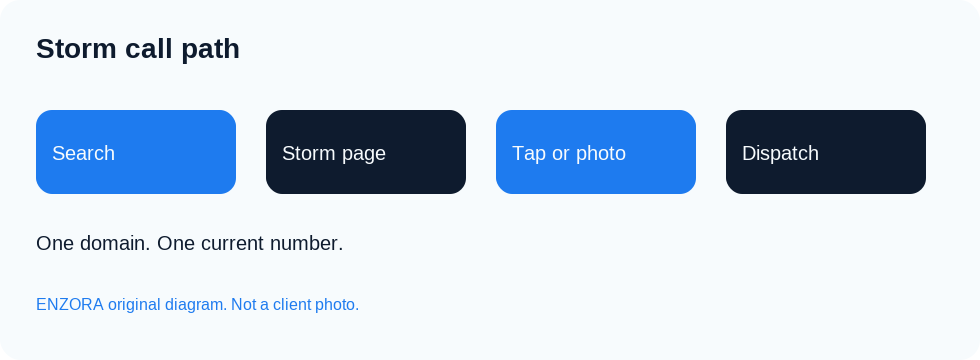
The call path diagram is search, storm page, tap or photo, your dispatcher. Compare it with the live page. Roofers who share the same night can read the roofing trust guide. A leak inside the house is the plumber call guide.
Before the next warning, call your own storm number from a second phone. If it does not reach the on call lead, fix the route. A pretty page with a dead number is a missed job.
Insurance and safety proof
Homeowners ask if you are insured because the work can damage a roof, a fence, or a car. Say that you carry insurance, and that you will email the certificate. Do not post an old PDF that has expired. Do not claim a coverage amount you have not checked. If you are unsure of the words, ask your agent for a sentence you may publish.
Safety belongs in plain language. You use the right gear, you keep people out of the drop zone, and you do not ask the customer to hold a rope. Certifications go on the page only when a crew member holds them now. A badge saved from a website kit is not a credential. Take it off.
If you subcontract crane work, say so when that is true. People can accept a partner. They do not accept a surprise truck. The same goes for stump grinding if another company does it. Honesty filters jobs you do not want.
This week, open the proof block and read every noun. If you cannot show a certificate or a card for it, delete the line. Local SEO still needs that block to match the real company, not a fictional one.
One domain, not two
Some crews bought a second domain for storms, or an old site still sits online. Neighbors then see two names, two phones, or two galleries. Pick the domain you want on the truck and make the other one send people there. Google's redirect guide explains that a permanent redirect passes people and signals to the new address. A temporary hop, or a chain of several hops, is a weaker plan.
Do the redirect at the domain, not only as a link that says click here. Test it. The redirect checker shows the hops. You want one clean hop to the storm page or the home page, with the final address using https. If the old site still ranks with a different phone number, update that number before you wait on search.
Keep email and the Google profile on the same name. A profile that points at the domain you just retired keeps the split alive. Change the website field on the profile the same day you flip the redirect.
This week, list every domain you own. Choose one. Point the others at it and run the checker until you see a single hop and a page that loads. Write the winner on the truck and the invoice so crews stop sharing the old link.
Service area clarity
Storm calls come from farther away than Tuesday pruning. Write the towns you will enter when roads are open, and the ones you will not. "We serve the metro" is vague. A list of cities you can reach, plus a note about longer drives, is something dispatch can follow. If a town is a maybe, leave it off until you mean yes.
Say how you prioritize. Houses with people stuck, or a tree on a roof, may come before a limb in a yard. You do not need a complex chart. One sentence is enough if the office will follow it. Do not promise first in line to everyone.
A map image can help if the shaded area matches the list. A map of the whole state, when you work in one county, creates bad leads. Update the list when you add a truck or drop a far town.
This week, read the area list to the person who answers the phone. If they disagree with a town, fix the page. The tree service page is the trade page for this work. Keep this town list on your own site and do not make it wider than you drive. Add a line about roads you will not take when they are closed. If a town is only a favor for friends, leave it off the public list.
Photo proof
Photos win the calm jobs and the storm jobs. Show removals, pruning, and crane picks you really did. Include the mess and the clean yard if the owner agreed. A logo over a stock forest does not prove you own a chipper. Date the work in the caption only when you know the season. Wrong dates look like a trick.
Crew photos help if they are your crew and they agreed to be shown. Do not grab faces from a supplier brochure. Gear photos, such as a chip truck with your name, tie the site to the vehicle in the driveway.
Put a storm album where the emergency page can link it. During a long outage, you may not have time to upload. Build the album on a quiet week. Google's image guide fits here: the picture should match the words, and you should have the right to show it.
This week, pick a handful of real jobs and replace the weakest images on the home page. Name the town in the caption when you can. Put the storm album one tap from the emergency number so people do not hunt for proof. Retire any photo that shows a different company name on the truck.
Storm season SEO
Do not wait for the warning to write the page. Publish the storm page, the area list, and the proof while the calendar is quiet. Search needs time to see a page, and you need time to fix a broken form. A thin page posted the morning of a storm, full of repeated town names, is not a plan.
Use the same phone on the page, the profile, and the truck. Ask for reviews after cleanups when the customer is safe and calm, not in the middle of the debris. Real reviews only. The eCFR rule on reviews (16 CFR part 465, edition dated 1 Jan 2026) bars fake ones.
Write titles that say tree removal or storm cleanup and the city, for pages you can support. Do not create a page for every neighborhood with the same paragraph. One strong area page beats a pile of copies.
On a clear week, read the storm page, send a test form, and click the old domain. If all three work, you are ready. If one fails, fix it before the forecast turns. Ask a friend outside the crew to find the number without help. If they open the wrong domain first, the redirect is still not obvious enough.
Next step
Want a check of the storm path? Get a free site review. Tell us the towns you cover after a storm. We will look at the number, the domain, and the proof. We will not invent a response time.
Questions
What should a storm page for a tree company say?
Lead with how to call, what counts as an emergency, and the towns you will drive. Say if you can clear a tree off a house or only off a driveway. Do not promise you will arrive before every other crew. Honest timing keeps the call useful.
How do I show insurance without saying too much?
Say you carry liability insurance and that you will send the certificate when asked. Name the work the policy is for only if you have read it. Do not imply you cover the homeowner's deductible or that a claim is guaranteed. Offer the proof, not a slogan.
Why is one domain better than two?
Two sites split your name, your photos, and your links. Neighbors cannot tell which number is current. Pick one domain and point the other at it with a proper redirect. Check the hops so the old address does not loop or land on an error.
How far should my service area page go?
List towns you will reach after a storm, including the ones that take longer. Leave off counties you will not enter. A map that covers a whole state brings calls you must refuse. Clear limits save fuel and bad reviews.
What photos help after a storm?
Show your crew, your gear, and real trees you removed, with the street context if the owner allowed it. Skip stock forests. A before and after of a limb on a roof is worth more than a logo on a sunset. Update the set when you do new work.
Was this helpful?
Related ENZORA services
Want help with your website?
Get a fixed quote from the ENZORA team. We work with businesses worldwide.