For Home-Service Pros
Roofing Website Design: What Homeowners Look For Before They Call
By Fidyan Ahmed, founder · Published · Last updated · 7 min read

On this page
Homeowners call a roofer they can check. Roofing website design should answer four quiet questions fast: who you are, where you work, what the roof will look like, and how to reach you. If those answers are missing, the next company gets the tap.
Key takeaways
- Put proof you are a real local company above the fold, next to the phone number.
- Give storm damage its own page, and do not promise what a carrier will pay.
- Show your own before and after photos, not a stock house.
- Keep the first screen light so it opens on a phone after a storm.
Trust signals homeowners scan for
People rarely read a roofing page from top to bottom. They scan for signs you exist. A street address or a clear service area, a phone number that taps, and a business name that matches your truck all help. So does a license number when your state issues one. If you carry insurance, say so in a sentence a person can understand, and be ready to send the certificate when they ask. A badge with no meaning is not proof.
Skip claims you cannot stand behind. "Best roof in the state" and "we beat every quote" are noise. "Family owned since" needs a true year. If you are not sure, leave the year off. The eCFR rule on consumer reviews (16 CFR part 465, edition dated 1 Jan 2026) also bars fake reviews. Do not invent a homeowner to fill a hole on the page.
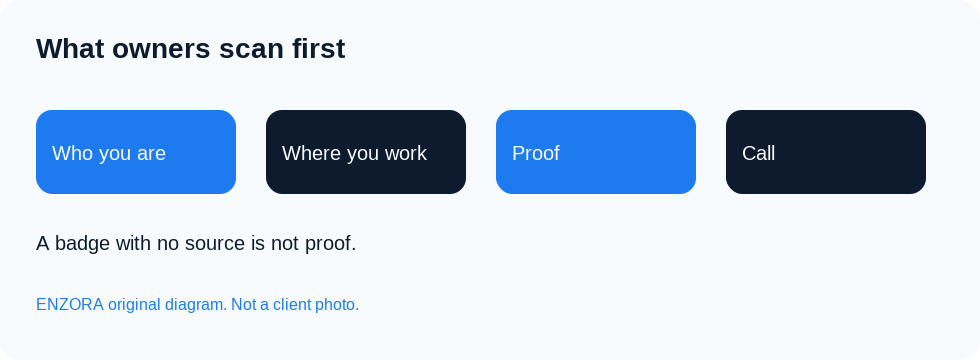
Picture a homeowner with a ceiling stain. They open two sites in two tabs. One shows a skyline and the words "trusted experts." The other shows the towns you drive, a tappable number, and a line about license and insurance. The second tab feels safer to call. The trust scan diagram is that order: who, where, proof, call.
This week, read your home page out loud and circle every claim. Keep the ones you can show on paper. Delete the rest. Roofing pages should start from that pass, not from a new font.
Storm damage and insurance pages
Storm work is a different page from a planned replacement. People are stressed, wet, and comparing trucks the same day. The page should say how to reach you, what an inspection is for, and what you will look at: missing shingles, lifted flashing, ceiling leaks, and tarps. Say what you will not do, such as promise a claim result.
Insurance is the carrier's decision. You can explain that you will document what you see and meet an adjuster when that is your real process. You cannot honestly say "your insurance will pay" or "we waive the deductible" as a blanket line. Those offers can be illegal in some states, and they are a trust problem everywhere. If you are unsure of your state's rule, ask your insurer or a local advisor before you print the line. Leave it off until you know.
Name the storms you are ready for in plain words, such as wind and hail, if that is the work you do. Do not list disasters you have no plan for. If you tarp only, say that. If you replace, say that too, and keep the steps in order: make it safe, inspect, write what you found, then talk about a new roof.
After the next warning from the weather service, open this page on a phone. The number should be the first thing a person can tap. If the page still leads with a sale on gutters, move the storm steps up.
Galleries that sell
A roof is a visual purchase. Homeowners want to see the before, the after, and the street, not a catalog render. Use photos your crew took. Shoot from the ground and, when it is safe, from a similar spot after the job. Label the town if you served it, and the material if you know the name. "Architectural shingles in Oak Street's color" is useful. "Beautiful roof" is not.
Do not use a stock photo of a house you never touched. Do not mirror the same house and call it two jobs. Google's image guidelines for search favor images that match the page and that you have a right to show. A caption that tells the truth helps both people and search.
Group photos by job type. Storm patches, full replacements, and flat roofs should not sit in one unlabeled slider. A person with a low slope roof should not have to guess if you do that work. A short set of clear jobs beats a pile of tiny tiles.
This month, pick six jobs you are proud of and that you have rights to show. Put before and after pairs on the site with one true caption each. Remove any photo you cannot explain to the homeowner who owns that house.
Inspection booking forms
An inspection form is a way to get the address and the problem, not a contract. Ask for the name, a mobile number, the property address, and what they see. Offer a photo upload. A good photo of a ceiling stain or a missing shingle saves a wasted trip. Do not require the insurance policy number before you have spoken.
Tell them what the visit is. "We look, we take photos, and we explain options" is clear if that is true. "Free" is fine only when you do not bill for the look. If you charge for a diagnostic, say so before they send the form. Surprise fees end the relationship.
Say when you reply. If you return calls the same day during business hours, you can write that, and then do it. If storm weeks run behind, say you are booking in the order requests arrived. A fake clock makes angry callers.
Send the form to the person who schedules, not to a general inbox nobody owns. Put the address in the subject so the crew can route the day. Test the form after every change to the page.
This week, fill out your own form on a phone. If you quit before the end, the form is too long. Cut a field and send a test until it lands with the scheduler.
Reviews and certifications
Reviews should be real words from real jobs. Link to the profile where they live. Do not edit a complaint into praise. You may answer a review in public with what you did next, without attacking the person. Manufacturer certificates belong on the page only when you hold them now. If a cert expired, take the logo down. A logo you downloaded is not a credential.
Training and safety cards work the same way. Name them plainly. "Our crew uses harnesses on steep roofs" is a practice. A badge that says "certified" with no issuer is not. If a supplier lists you on a public finder, you can link that finder. If they do not, do not fake the mark.
Pair reviews with the gallery. A quote about a hail job next to that job's photos is stronger than a carousel of stars with no story. Do not add a star rating in code unless it matches reviews people can see. The review snippet guide is the rule for that markup.
This week, list every logo in your footer. For each one, write where a stranger can confirm it. Remove any logo you cannot confirm. Keep two recent reviews in the homeowner's words, with a link to the rest.
Mobile speed
Storm traffic hits phones. A slow hero photo of a roof at sunset can block the number. Resize images, and do not autoplay a drone video on the first screen. Google explains loading and stability in the Core Web Vitals guide. You do not need a perfect lab score to help a caller. You need the number and the storm line to show without a long wait.
Test on cellular data, outside the office. Rooftop photos are large. A width that fits a phone is enough for the first screen. Offer the full photo on tap if someone wants detail. That pattern keeps the page light and the gallery honest.
Run the speed checker on the home page and the storm page. If the checker flags the first image, compress it and test again from a parking lot, not from desk Wi-Fi. Turn off any slider that loads extra roofs before the number. One still photo is enough for the first view. Web design is the right help when the template itself is the weight. Crews who also clear trees after wind can read the storm call guide for tree work. Plumbers fixing interior leaks can use the plumber call guide.
Next step
Want a calm look at the trust path? Get a free site review. Tell us if you take storm work. We will look at proof, photos, and the inspection form. We will not guess what a carrier will pay.
Questions
What do homeowners check on a roofing site before they call?
They look for a real phone number, proof you are local, and photos of roofs you actually replaced. License and insurance lines matter when your state or the carrier asks for them. A page of slogans with no way to check you is easy to skip.
Should storm damage have its own page?
Yes, if you take storm work. Explain how to reach you, what an inspection visit is for, and that the insurance carrier decides the claim. Do not promise an approval or a free roof. A calm page beats a scare headline.
How should a roofing gallery be set up?
Use your own before and after photos, shot from a similar angle, with the city if you can say it. Skip stock houses. Label the material when you know it. A gallery that could belong to any company in the country does not help you.
What belongs on an inspection form?
Ask for the name, mobile, address, and what they see, such as a leak or missing shingles. A photo helps. Tell them when you will reply. Do not require a full insurance packet before you have even called them back.
Why does speed matter for a roofer site?
After a storm, people are on phones and the signal can be weak. If a huge photo blocks the number, they call the next truck. Shrink the first image and test on cellular data. The page should show the number quickly.
Was this helpful?
Related ENZORA services
Want help with your website?
Get a fixed quote from the ENZORA team. We work with businesses worldwide.